

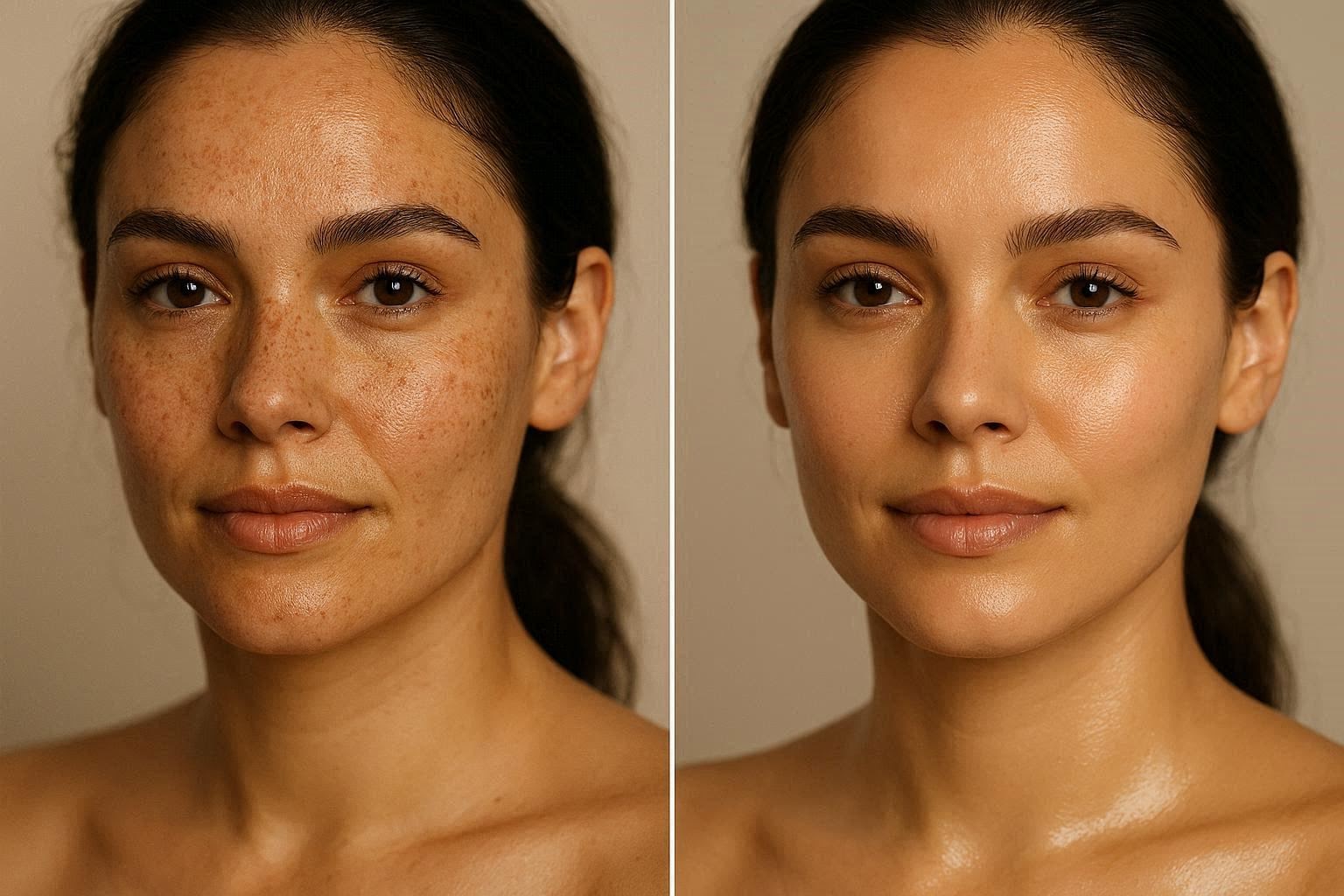

I want to start with the thing nobody says clearly enough:
Fading hyperpigmentation is slow. Even when you are doing everything right.
Not because the treatments don’t work — they do. But because melanin production is a biological process that operates on its own timeline, and no serum, no matter how expensive, can override that timeline completely.
What you CAN do is significantly accelerate it. With the right ingredients, used in the right order, with the consistency that most routines lack.
I know this because I spent two years getting it wrong before I got it right. Here is everything I learned — compressed into the guide I wish I had found at the beginning.
What Is Hyperpigmentation — And Why Is Yours Happening?

Hyperpigmentation is the umbrella term for any area of skin that appears darker than the surrounding tissue due to excess melanin production. But “hyperpigmentation” is not one thing — it is several different conditions that look similar but have different causes and respond to different treatments.
Post-Inflammatory Hyperpigmentation (PIH)

The dark marks left after acne, a wound, or skin inflammation. These are the most common type and the most responsive to topical treatment.
Appears as: flat, dark marks — brown, red, or purple depending on skin tone — in areas where breakouts or injury occurred.
Who gets it most: darker skin tones produce more melanin in response to inflammation, making PIH more pronounced and longer-lasting.
Melasma

Larger patches of discoloration — often symmetrical — typically appearing on the cheeks, forehead, upper lip, and chin. Strongly associated with hormonal fluctuations.
Triggered by: pregnancy, hormonal contraceptives, sun exposure, and heat.
The challenge: melasma is chronic and can recur even after fading. It requires ongoing management rather than a one-time treatment.
Sun Spots (Solar Lentigines)

Flat, defined spots that appear in areas of repeated sun exposure — typically the face, hands, shoulders, and décolletage.
Who gets it: most common in women over 40 with significant sun exposure history.
Good news: highly responsive to topical vitamin C and consistent SPF.
Why Your Current Routine Isn’t Working

Most hyperpigmentation routines fail for one of three reasons.
Reason 1 — You are treating without protecting.
If you apply brightening serums every evening but skip SPF every morning, you are losing ground faster than you are gaining it. UV exposure is the primary driver of melanin production. Every unprotected minute in daylight is actively making your dark spots darker. SPF is not optional for hyperpigmentation — it is the foundation of every effective treatment protocol.
Reason 2 — You are using one ingredient instead of two or three.
Each brightening ingredient works on a different step of the melanin production process. Combining two or three complementary ingredients simultaneously attacks the problem from multiple angles and dramatically accelerates results.
Reason 3 — You are not being consistent long enough.
Hyperpigmentation develops over months. Fading it takes months. Most people abandon their routine at week four or six — exactly when the process is beginning to work. The clinical standard for assessing brightening treatments is 12 weeks minimum.
The 3 Ingredients That Actually Work
Ingredient 1 — Vitamin C (The Brightening Foundation)

Vitamin C is the most well-researched brightening ingredient in skincare and the cornerstone of every effective hyperpigmentation routine.
It works by inhibiting tyrosinase — the enzyme that converts tyrosine into melanin. Less tyrosinase activity means less new pigment is produced. Applied consistently morning and evening, it prevents new dark spots from forming while existing ones fade.
The formulation matters enormously:
– L-Ascorbic acid is the most potent form but oxidizes quickly — store in a dark, cool place and replace when it turns yellow or orange
– Ascorbyl glucoside is more stable and well-tolerated by sensitive skin
– Sodium ascorbyl phosphate is the most gentle option — ideal for reactive skin
Concentration: 10-20% for significant brightening. Below 10% provides antioxidant protection but limited pigmentation impact.
When to use: morning, after cleansing and toning. Allow to absorb for 5 minutes before SPF.
Results timeline: subtle improvement at weeks 4-6, visible improvement at weeks 8-12.
Ingredient 2 — Azelaic Acid (The Targeted Fader)

Azelaic acid targets melanin production with a precision that vitamin C cannot match. While vitamin C broadly inhibits tyrosinase throughout the skin, azelaic acid specifically targets the hyperactive melanocytes — the cells overproducing pigment — without affecting normally-functioning ones.
This makes it particularly effective for PIH and melasma, where the problem is localized overproduction rather than generalized increased pigmentation.
Additional benefit: azelaic acid is anti-inflammatory, which means it simultaneously reduces the inflammation that triggers PIH in the first place. It treats the existing marks while preventing new ones from forming.
Concentration: 10% over the counter is effective. 15-20% requires prescription.
When to use: evening, after cleansing and toning.
Safe for: pregnancy, sensitive skin, rosacea-prone skin. One of the most gentle actives available.
Results timeline: 6-8 weeks for visible improvement on PIH. 12-16 weeks for melasma.
Ingredient 3 — Niacinamide (The Stabilizer and Amplifier)

Niacinamide works on a completely different step of the pigmentation process from vitamin C and azelaic acid. While those two inhibit melanin production, niacinamide inhibits the transfer of melanin from the cells that produce it to the skin cells that display it.
Think of it this way: vitamin C and azelaic acid reduce how much pigment is made. Niacinamide prevents the pigment that is made from reaching the surface. Used together, they create a comprehensive block on the entire pigmentation pathway.
Additional benefits relevant to hyperpigmentation:
– Strengthens the skin barrier — reducing the inflammation that triggers PIH
– Reduces sebum production — minimizing breakouts that cause PIH
– Improves overall skin clarity and radiance
When to use: morning and evening. It layers well with virtually every other ingredient.
Concentration: 5-10%. Highly effective at this range.
The Complete Hyperpigmentation Routine

Morning
1. Gentle cleanser
2. Hydrating toner
3. Vitamin C serum (10-20%) — wait 5 minutes to absorb
4. Niacinamide serum (5-10%)
5. Lightweight moisturizer
6. SPF 30 minimum — reapply every 2 hours if outdoors
Evening
1. Double cleanse — oil cleanser first, then water-based
2. Exfoliating toner (AHA — glycolic or lactic acid) — 2-3 nights per week only
3. Azelaic acid serum (10%)
4. Niacinamide serum
5. Moisturizer with ceramides
Weekly
On exfoliation nights: replace the AHA toner with a 15-minute AHA mask for deeper surface renewal. Do not combine with azelaic acid on these nights.
The Ingredient Combinations to Avoid

Vitamin C + Niacinamide at the exact same time:
There is historical concern about these two ingredients reacting and forming a compound called nicotinic acid, which can cause temporary flushing. Current evidence suggests this reaction is minimal with modern formulations. The simplest approach: apply vitamin C in the morning and niacinamide in the evening if you want to be cautious.
AHA/BHA + Azelaic acid on the same night:
Both are actives that work on the skin surface. Combining them increases the risk of irritation without proportionally increasing the benefit. Alternate them: exfoliation nights 3 times per week, azelaic acid on the remaining evenings.
Any active + retinol without spacing:
If you choose to add retinol to your hyperpigmentation routine (which is effective for sun spots in particular), designate it to specific nights within your skin cycling schedule and avoid layering it directly with vitamin C or AHAs.
What to Expect — The Honest Timeline

Week 2-3: skin texture improves. Surface appears smoother and more even even before pigmentation has visibly faded. This is the exfoliation and barrier strengthening working.
Week 4-6: the edges of dark spots begin to soften. They may appear slightly less defined rather than dramatically lighter at this stage.
Week 8-10: visible fading is occurring. PIH marks are noticeably lighter. Sun spots have begun to fade at the perimeter.
Week 12: significant improvement for most types of hyperpigmentation. Melasma may require ongoing treatment beyond this point.
The critical rule: if you stop at week 6 because you are not seeing dramatic results, you will have stopped exactly as the significant changes are beginning. The biological process of fading existing melanin has a minimum timeframe that cannot be rushed beyond a certain point.
Product Recommendations
Vitamin C:
– TruSkin Vitamin C Serum — affordable, stable formula, widely loved
– SkinCeuticals C E Ferulic — the gold standard, significant investment
– The Ordinary Ascorbyl Glucoside Solution 12% — gentle and budget-friendly
Azelaic Acid:
– The Ordinary Azelaic Acid Suspension 10% — $10, excellent starting point
– Paula’s Choice 10% Azelaic Acid Booster — elegant texture, higher price
Niacinamide:
– The Ordinary Niacinamide 10% + Zinc 1% — cult product, genuinely effective
– CeraVe PM Facial Moisturizing Lotion — contains niacinamide, doubles as moisturizer
SPF (the most important product on this list):
– EltaMD UV Clear SPF 46 — specifically formulated for hyperpigmentation-prone skin
– La Roche-Posay Anthelios SPF 60 — excellent protection, elegant finish
How long have you been dealing with hyperpigmentation? Tell us the type — PIH, melasma, or sun spots — and we will give you a specific product recommendation for your situation. 🌿
You’ll Also Love:
– How to Minimize Pores: 3 Ingredients That Make Them Disappear
– What Is Azelaic Acid? The Skincare Ingredient Everyone Is Searching
– How to Get Glass Skin: The 6-Step Korean Routine
Disclosure: THE CHIC STYLE LOOK is a participant in the Amazon Associates Program and also shares Shein affiliate links. As an Amazon Associate, we earn from qualifying purchases. We may also earn commissions from Shein links — all at no extra cost to you. Thank you for supporting our work.