

You have watched the tutorials. You have bought the liner. You have tried and wiped and tried again.
And one side always comes out perfect. The other side looks like a different person did it.
Welcome to the most common frustration in makeup. You are not alone. And more importantly — you are not doing it wrong. You are doing it the same way everyone does it, which is the wrong way for most eye shapes.
Here is the technique that actually works. For every eye shape. Every time.
Why Most Winged Liner Tutorials Fail You

The standard tutorial instruction is: “draw a line from the inner corner outward, extending at the outer edge into a wing.”
This instruction assumes you are drawing on a flat surface. Your eye is not a flat surface.
When you close your eye to draw liner, the lid stretches and distorts. When you open your eye, the line you drew shifts, compresses, and moves — because your lid folds. The wing ends up in the wrong place, at the wrong angle, with the wrong thickness.
The entire approach is wrong for anyone with a visible lid fold — which includes hooded eyes, monolids, and most eyes over 35 as the lid begins to change with age.
The fix is not a steadier hand or a better product. The fix is drawing the liner with your eyes open.
The One Rule That Changes Everything

Draw your wing with your eyes open. Always.
Not partially open. Not looking down. Eyes open, looking directly forward into a mirror placed at eye level — not above you, not tilted up. Directly in front of you.
This single change solves 80% of winged liner problems because:
– You see exactly where the line will sit when your eye is open
– You can adjust the angle to follow your natural lid shape
– The wing lands where you actually want it — not where the closed-eye muscle placement puts it
The Complete Winged Liner Tutorial — Step by Step
Step 1 — Prep the Lid

Apply a thin layer of eyeshadow primer or a matte skin-toned eyeshadow across the lid. This creates a surface for the liner to grip rather than sliding.
Skip this step and your liner will smudge within hours regardless of how waterproof the formula claims to be. Include this step and your liner will last all day.
Step 2 — Plan Your Wing First

Before drawing any line, hold your liner brush or pen against the outer corner of your eye and tilt it upward — following the direction your lower lash line would naturally extend if continued outward.
This is your wing angle. Every eye shape has a different natural angle, and this is how you find yours without guessing.
Mark a small dot at the point where your wing will end. This is your target. Everything you draw will connect to this dot.
Step 3 — Draw the Wing Outline First
.png)
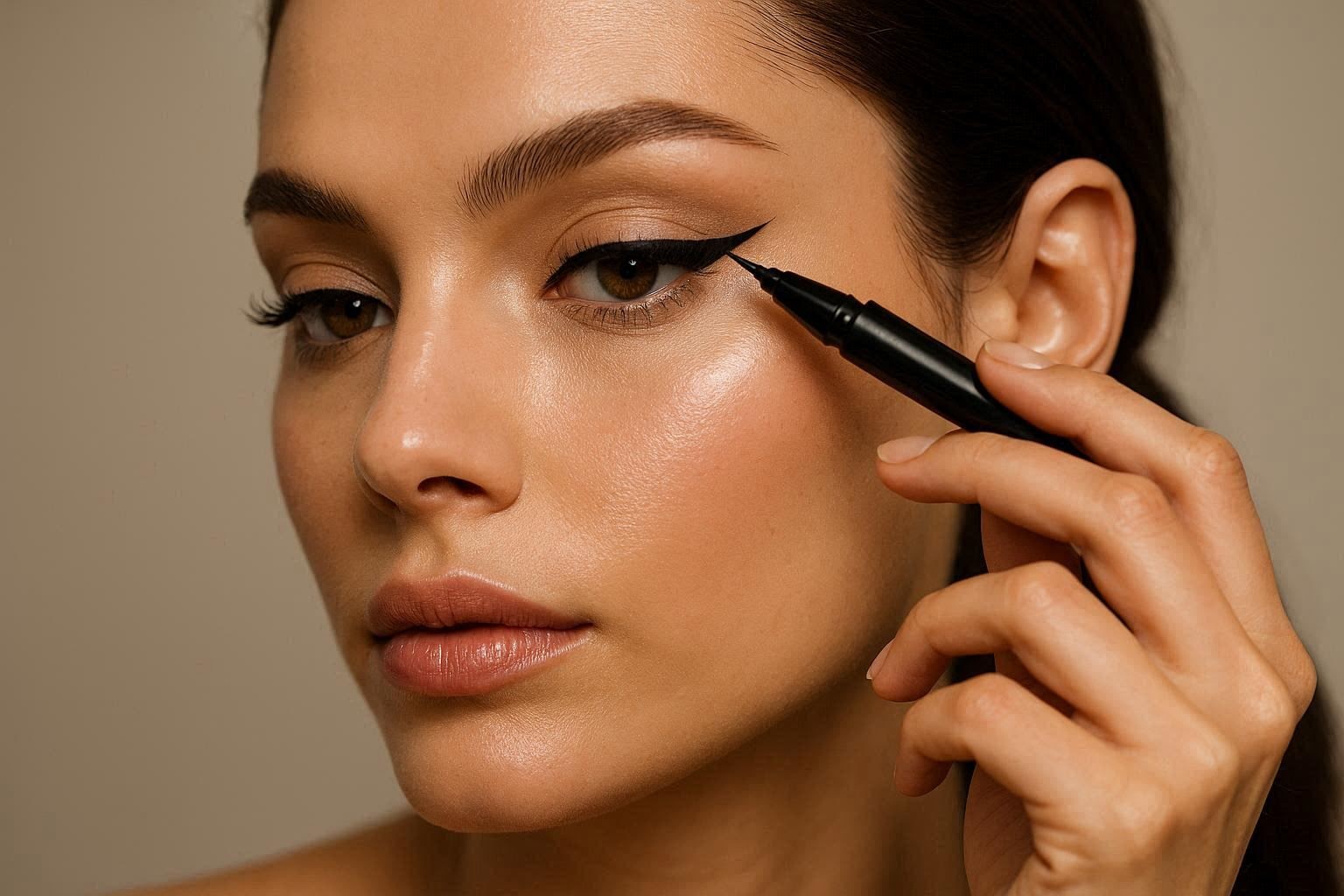
With your eyes open, draw the upper edge of your wing — from the dot back toward the outer corner of the eye. This is the angled line that creates the wing shape.
Then draw the lower edge of the wing — from the dot back to meet the lash line.
You now have an empty triangle at the outer corner of your eye. This is your wing outline.
Step 4 — Fill in the Triangle

Fill in the triangle you just created. Use small, pressing motions rather than a single sweeping stroke — this gives you more control and prevents the wobble that causes uneven wings.
Step 5 — Draw the Lash Line

Now — with your eyes still open — draw the line along the upper lash line from the inner corner outward, connecting to the filled triangle.
Drawing the lash line last (instead of first) means any imprecision in the inner corner is less visible — the eye naturally draws attention to the dramatic outer wing first.
Step 6 — Check and Correct

Step back from the mirror. Look at both eyes simultaneously.
For any corrections: a pointed cotton swab dipped in micellar water or concealer lifts liner mistakes precisely. A small flat brush loaded with concealer applied directly over a mistake and blended upward creates a clean edge and makes the wing appear even sharper than the original.
Winged Liner for Every Eye Shape
Hooded Eyes

The challenge: the lid fold covers most of the wing when eyes are open.
The solution: draw the wing slightly higher than feels natural — angling upward more dramatically than you think necessary. When the lid closes over the inner portion, the visible wing will be at the right level.
Extra tip: apply white or nude liner on the waterline to open the eye and create space for the liner to show.
Round Eyes

The challenge: the natural roundness can make a standard wing look overly dramatic.
The solution: extend the wing more horizontally than upward — this elongates the eye shape and creates balance.
The angle: point the wing toward the end of your eyebrow rather than upward toward the brow arch.
Downturned Eyes

The challenge: following the natural eye shape makes the wing point downward, emphasizing the droop.
The solution: angle the wing upward, against the natural downward pull of the outer corner. Start the upward angle from the middle of the lash line rather than the outer corner.
The result: a lifted, brightened appearance that counteracts the downward direction of the eye.
Almond Eyes

The challenge: there is no challenge. Almond eyes suit virtually every wing style.
The opportunity: experiment with graphic, extended wings or double wings. The balanced, symmetrical shape of almond eyes can handle more dramatic interpretations.
Monolid Eyes

The challenge: there is no visible lid crease, which means the wing must be designed to show on a flat surface.
The solution: draw the wing while eyes are open (even more important than for other eye shapes). Angle more dramatically upward. A thicker wing with a longer extension creates the most visible, flattering result.
The Best Eyeliner Formulas for Winged Liner

The formula determines how much time you have to correct and how long the finished look lasts.
Felt-tip liner pen (Best for: beginners and precision):

The pen format gives you the most control because the tip is rigid and consistent. You always know how much product you are getting. The line is immediate and opaque. The downside: dries quickly, so corrections must be made fast.
Liquid liner with a brush tip (Best for: advanced, maximum drama):

The brush tip allows variation in line thickness — thin at the inner corner, gradually thicker toward the outer edge. Requires a steadier hand but produces the most professional result.
Gel liner with a brush (Best for: smudgeable precision):

The gel formula stays workable slightly longer than liquid, giving you more time to refine. Apply with an angled liner brush for precision. Excellent for building thickness gradually.
Kajal or kohl pencil (Best for: softer, more forgiving wings):

A sharpened pencil gives more control than most tutorials suggest. Draw the outline, then sharpen the edges with a brush. Softer and more forgiving than liquid formulas.
What to avoid: waxy, soft pencil liners for winged liner. They smudge immediately and cannot be built into a clean edge.
The Products That Don’t Move
For beginners:
– NYX Professional Makeup Epic Ink Liner — $10, felt-tip, opaque, forgiving
– e.l.f. H2O Proof Eyeliner — $12, waterproof felt-tip
For intermediate:
– Stila Stay All Day Waterproof Liquid Eye Liner — $22, brush tip, genuine 24-hour wear
– KVD Beauty Tattoo Liner — $25, the precision liner that professionals trust
For advanced:
– Inglot AMC Eyeliner Gel — $18, gel pot with brush, maximum customization
– Marc Jacobs Highliner Gel Eye Crayon — $30, gel pencil with extraordinary pigment
For hooded eyes specifically:
– Any waterproof formula — the lid fold creates friction that removes non-waterproof liner by midday
The Symmetry Trick That Professionals Use

Perfect symmetry between both eyes is the goal that most people abandon after three failed attempts. Here is how professionals achieve it every time:
Work on both eyes simultaneously. Do not complete one eye before starting the other. Draw the dot on both outer corners. Then draw both wing outlines. Then fill both triangles. Then draw both lash lines.
This approach keeps both eyes in the same stage of completion — so you can compare and adjust as you go, rather than finishing one perfect eye and then trying to match it on the other side.
The small-strokes method: instead of one confident long stroke, build the line from three to four short overlapping strokes. Each stroke can be corrected before the next one begins.

Which eye shape are you working with? Drop it in the comments and we will give you the exact angle recommendation for your specific wing. 👁️
You’ll Also Love:
– Makeup Tips for Women Over 40 That Actually Make You Look Younger
– The Perfect Smoky Eye in 5 Easy Steps
– Best Foundation for Mature Skin: 5 Formulas That Don’t Settle Into Lines
– Korean Skincare 2026: The Complete Glass Skin Guide
Disclosure: THE CHIC STYLE LOOK is a participant in the Amazon Associates Program and also shares Shein affiliate links. As an Amazon Associate, we earn from qualifying purchases. We may also earn commissions from Shein links — all at no extra cost to you. Thank you for supporting our work.