

There is a specific morning many of us face in our 40s. You sit down at your vanity, apply the same “holy grail” foundation you’ve used for a decade, look in the mirror, and realize: I look older with this on than I do without it.
The foundation that used to make you look flawless is now settling into lines you didn’t know you had. Your favorite matte lipstick is making your lips look thin. Your “reliable” powder is creating a texture that looks like dry parchment paper.
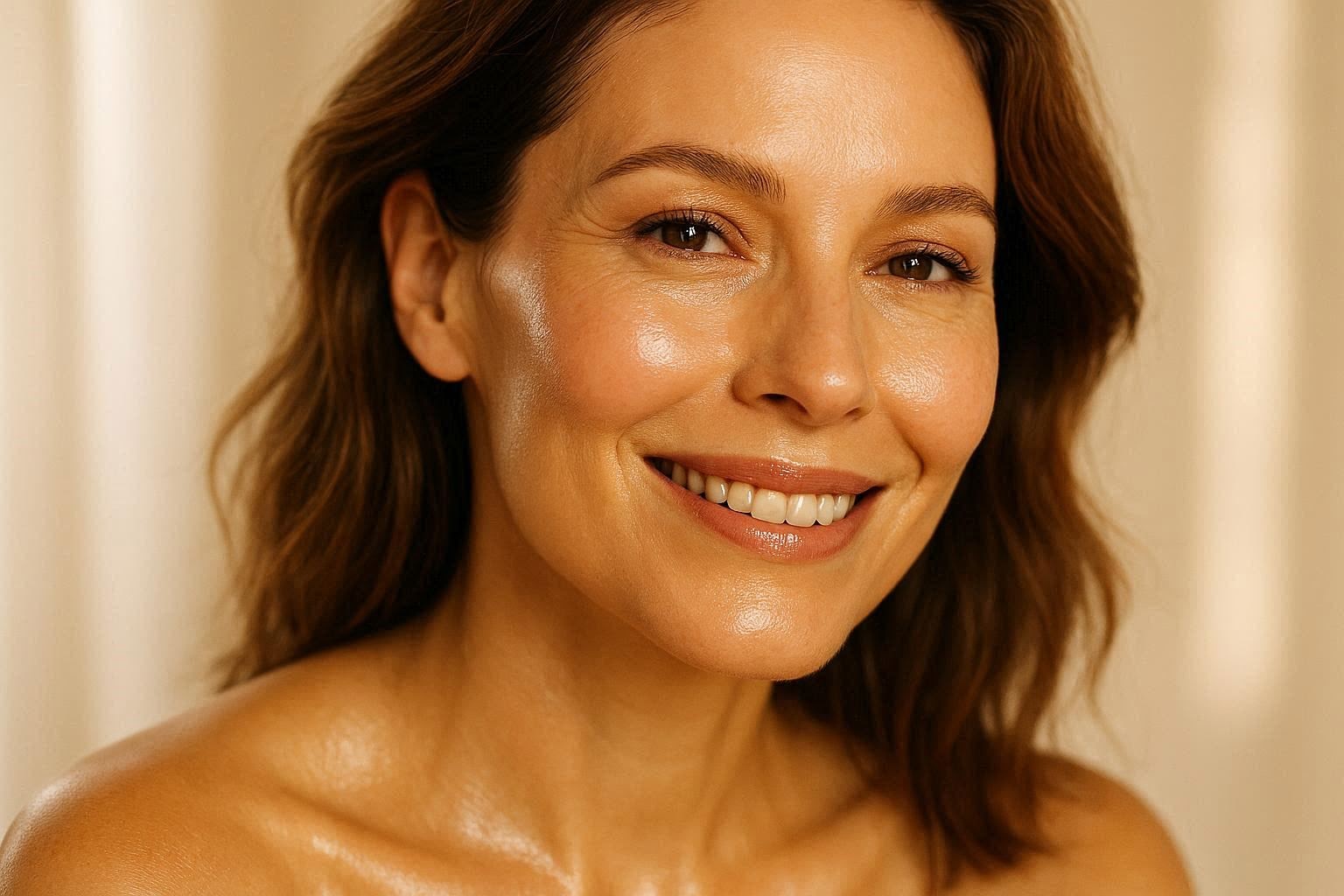
I hit that wall at 43. I spent months frustrated, thinking I just needed a better “mask.” But the truth of 2026 beauty is different: Mature skin doesn’t need more coverage; it needs more light. I had to unlearn the “matte and mask” habits of my 20s and embrace a strategy of luminosity and “bounce.” After testing dozens of products designed for “anti-aging,” I narrowed it down to the five that actually deliver. Here is how I reclaimed my glow and why your technique matters more than your budget.
The Science of Aging Perception: Why “Contrast” Matters

Before we talk products, we need to understand the biology of what makes a face look “young.” It’s not just about the absence of wrinkles.
The Science Check: Research in perceptual psychology (Porcheron et al., Journal of Psychology and Aging) confirms that humans perceive youth based on two primary factors: Skin Luminosity and Facial Contrast. As we age, our lips lose their natural flush, our brows thin, and our skin reflects less light. Most traditional makeup covers these markers. Heavy foundation kills luminosity; lack of definition reduces contrast. To look younger, we don’t need to hide; we need to strategically “add back” the light and the color.
My “Mature Glow” Testing Methodology

I spent 90 days re-evaluating my kit. To find the winners, I graded each product on:
The Crease Test: Does it settle into fine lines after 6 hours of wear?
The Light Test: Does it look natural in direct sunlight, or like a “mask”?
The Hydration Factor: Does the skin feel tighter or more moisturized by the end of the day?
The 5 Products That Changed My Face
1. The Game Changer: Ilia Super Serum Skin Tint SPF 40

The Strategy: Transitioning from “Foundation” to “Skin Tint.”
Heavy foundations are the #1 enemy of mature skin. They contain too much pigment and not enough “slip,” which leads to caking. The Ilia Skin Tint is a serum first. It’s packed with Hyaluronic Acid and Squalane.
Why it works: It doesn’t sit on the skin; it melts into it. It provides enough coverage to even out redness while letting your actual skin texture breathe.
The Result: My skin looked “plump” and dewy all day. I stopped getting the “cracks” around my mouth when I smiled.
2. The Optical Illusion: Charlotte Tilbury Hollywood Flawless Filter

The Strategy: Bouncing light away from texture.
This isn’t a foundation or a highlighter—it’s a “glow booster.” It uses finely milled bismuth oxychloride to reflect light.
Why it works: When you apply this to the high points of your face (tops of cheeks, bridge of nose), it creates an optical softening effect. It literally “blurs” the appearance of fine lines by redirecting how light hits the skin.
The Result: A “lit-from-within” look that mimics the sebum levels of younger skin.
3. The Lip Restorer: Charlotte Tilbury Lip Cheat (Pillow Talk)

The Strategy: Rebuilding lost facial contrast.
As our lips lose volume, the “border” becomes less defined, making lipstick bleed. A waterproof, waxy liner is the fix.
Why it works: By slightly over-lining in a “your lips but better” shade, you restore the youthful contrast between your lips and your skin.
The Result: Fuller-looking lips that don’t look “done.”
4. The Eye Opener: Rare Beauty Soft Pinch Liquid Blush

The Strategy: Using cream over powder.
Powder blush on a 40-year-old cheek can look like a dry patch. Liquid blush, however, mimics a natural flush.
Why it works: It blends seamlessly into foundation. Placing it slightly higher on the cheekbone (rather than the apples of the cheeks) creates an immediate “lifting” effect.
The Result: A healthy, vibrant look that doesn’t emphasize pores.
5. The Invisible Shield: Tower 28 SOS Daily Rescue Spray

The Strategy: Setting without the “Dry-down.”
Powder is often the death of a mature makeup look. Instead of setting with powder, I use a Hypochlorous Acid spray.
Why it works: It locks the makeup in place and calms any redness throughout the day without adding a single particle of dry texture.
The Result: Makeup that looks fresh at 6:00 PM as it did at 8:00 AM.
The 40s Upgrade: What to Change & Why
Foundation: Swap matte full-coverage for a hydrating skin tint. Heavy pigment settles into lines; serum formulas move with your skin.
Concealer: Ditch the heavy “under-eye triangle.” Use just two dots (inner and outer corner) to prevent creasing and cakeiness.
Brows: Trade bold, blocky shapes for feathery, upward-brushed strokes. This naturally lifts the eye area without looking drawn on.
Setting Powder: Skip “baking.” Use a hydrating setting spray instead. Powder sits on top of fine lines; spray melts everything together without drying texture.
The Technique That Changes Everything: Warmth & Pressing

The best product in the world will fail if you swipe it on like you’re painting a wall. For mature skin, warmth is your best tool.
The Palm Method: Warm your skin tint or cream blush on the back of your hand first. This “activates” the oils.
The Press: Use a damp beauty sponge or your ring finger. Press the product into the skin. Swiping creates micro-streaks that emphasize texture.
The “Check” Rule: After 10 minutes, take a clean, dry cotton swab and gently run it through your deepest lines (usually under the eyes). This removes the excess product that hasn’t set, preventing it from creasing later.
FAQ: Mature Makeup Secrets
Does cream makeup slide off oily skin?
Not if you prep correctly. Use a gripping primer only on the T-zone, but keep your cheeks “creamy.” Cream formulas bond better to hydrated skin than powder does.
How do I stop concealer from creasing?
Use less than you think. 80% of creasing is simply having too much product. Try a serum-based concealer like the one from Kosas, and always press it in rather than dragging it.
Should I use brown or black eyeliner?
Switch to a dark brown or charcoal. Black can look “harsh” against thinning skin; brown creates a softer, more sophisticated definition that enhances without aging.
Conclusion: Beauty is an Evolution, Not a Race Against Time

Switching my makeup routine wasn’t just about looking “younger.” It was about looking vibrant. In my 20s, I used makeup to change how I looked. In my 40s, I use it to celebrate how I feel.
By choosing hydrating formulas, embracing the “less is more” philosophy, and focusing on luminosity, I finally feel like the best version of myself. You don’t need to hide your age behind a matte mask. Let the light back in. Your lines tell a story—your makeup should just make sure that story is told in the best possible light.
What’s the one makeup product you’ve used for years that just doesn’t seem to work anymore? Tell me in the comments, and let’s find you a 2026 upgrade that restores your glow!
You Might Also Enjoy:
I Tested 7 Niacinamide Serums: The 60-Day Result
Best Herbal Tea for Skin: 7 Daily Brews That Hydrate, Calm & Support Collagen
My 8-Month Hair Growth Journey: What Actually Worked
Author’s Note on Transparency
I am a beauty editor and product tester. These results are based on my personal experience with mature skin. This post contains affiliate links, which support our independent testing. Thank you for being part of the community!
Disclosure: THE CHIC STYLE LOOK is a participant in the Amazon Associates Program and also shares Shein affiliate links. As an Amazon Associate, we earn from qualifying purchases. We may also earn commissions from Shein links — all at no extra cost to you. Thank you for supporting our work.