

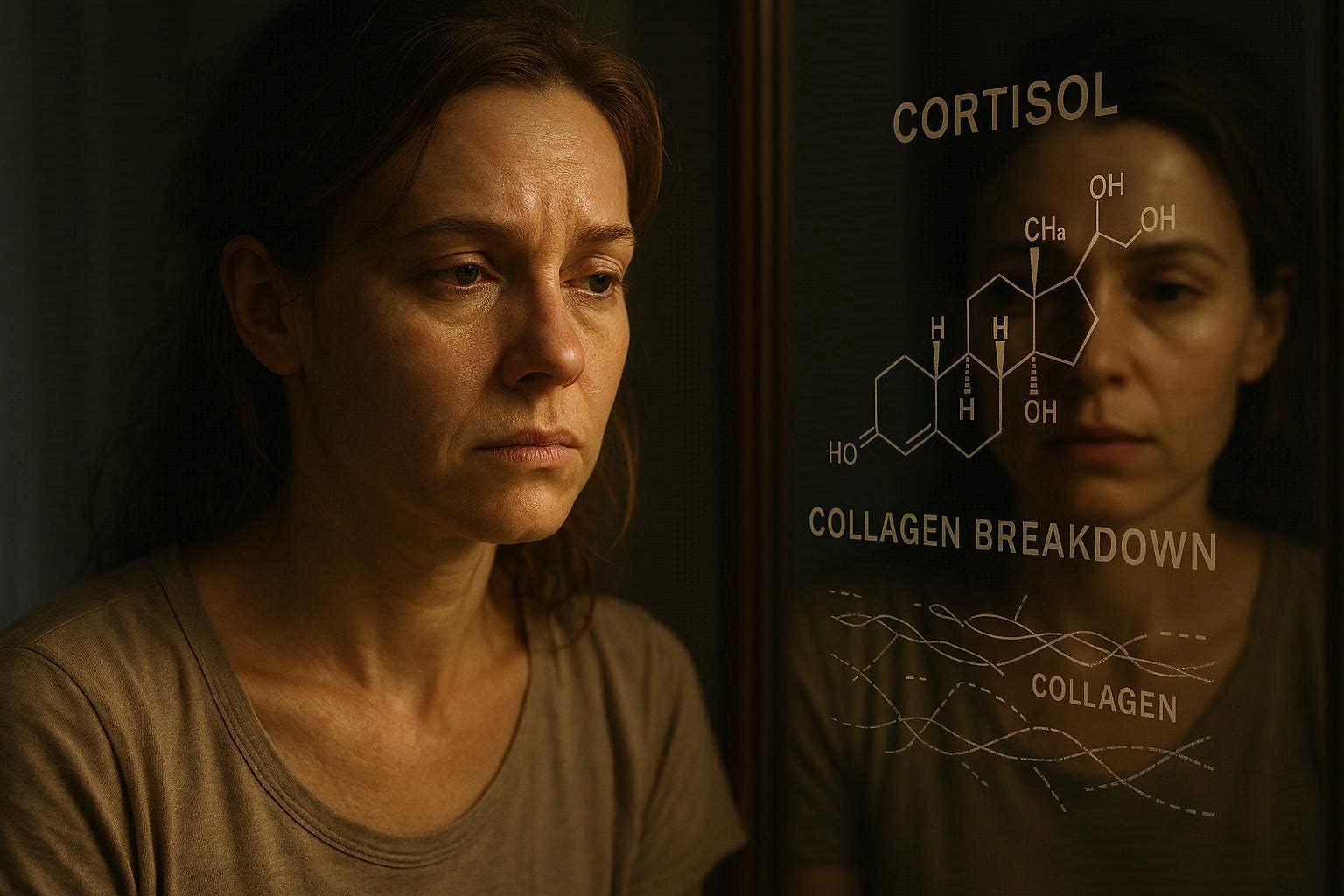

The Invisible Aging Factor
In 2026, we’ve moved beyond “anti-aging.” The real battle for your skin’s youth is being fought against your own adrenal system. You’re sleeping eight hours. You’re drinking water. You’re using “the right” serums. Yet you still look exhausted.
The culprit isn’t age. It’s cortisol.
When cortisol is chronically elevated, it becomes a tissue corrosive — silently breaking down collagen, triggering inflammation, and creating that puffy, tired appearance no amount of concealer can fix. This is what dermatologists now call “Skin Fatigue,” and it’s the primary reason women in their 30s and 40s look older than their chronological age.
Here is the science of how stress ages your face — and the biological protocol to reverse it.
⚠️ Medical Disclaimer: I am not a dermatologist, endocrinologist, or medical professional. This article shares research on cortisol’s effects on skin and evidence-based skincare strategies. Chronic stress and adrenal issues require medical evaluation. Always consult a qualified healthcare provider before making changes to your health or skincare routine, especially if you have hormonal imbalances, Cushing’s syndrome, or adrenal disorders.
The Biological Hijack: How Cortisol Steals Your Glow

When your body perceives stress — whether from work, inflammation, poor sleep, or environmental toxins — your adrenal glands release cortisol. This hormone is essential for survival in short bursts. But when it remains chronically elevated, it hijacks your skin’s biology.
The Collagen Breakdown
High cortisol directly inhibits fibroblast production — the cells responsible for synthesizing collagen and elastin. Research in Endocrine Reviews confirms that chronic cortisol exposure reduces collagen synthesis by up to 40% and accelerates the breakdown of existing collagen fibers through increased matrix metalloproteinase (MMP) activity.
You’re not just aging naturally. You’ve stopped self-repairing.
The “Puffy Face” Effect
Excess cortisol causes sodium retention in the interstitial layers of your face, creating that characteristic morning puffiness that doesn’t disappear by noon. This isn’t water weight — it’s interstitial fluid trapped by cortisol’s mineralocorticoid activity. Studies in Clinical Endocrinology show that elevated cortisol disrupts the sodium-potassium pump at the cellular level, leading to persistent facial edema even in well-hydrated individuals.
Additionally, cortisol impairs lymphatic drainage, meaning the fluid that should be cleared overnight remains trapped in your tissues. The result: a swollen, tired appearance that makes you look like you haven’t slept — even when you have.
💡 PRO TIP: If your face is puffiest in the morning and improves slightly by evening, this is a classic sign of cortisol-related fluid retention, not allergic reaction or poor sleep quality.
The 3 Pillars of the “Cortisol Reset”

Most skincare advice tells you to “reduce stress” — which is unhelpful if you have a job, children, or a life. At The Chic Style Look, we don’t recommend vague wellness platitudes. We recommend biology.
Pillar 1: Topical Adaptogens
Adaptogens are botanical compounds that help cells resist stressors. While traditionally taken orally, stabilized forms of ashwagandha and rhodiola rosea are now available for topical use.
Research in the Journal of Cosmetic Dermatology demonstrates that topical ashwagandha extract reduces cortisol-induced inflammation in skin cells by modulating the NF-κB pathway. Rhodiola rosea enhances cellular energy production (ATP synthesis) even under stress conditions, helping skin maintain repair processes when cortisol would normally shut them down.
These ingredients don’t lower your systemic cortisol — they help your skin “ignore” the stress signal, maintaining collagen production and barrier function despite elevated hormone levels.
Pillar 2: Blocking the 11β-HSD1 Enzyme
Here’s what most people don’t know: your skin produces its own cortisol. The enzyme 11β-hSD1 (11-beta-hydroxysteroid dehydrogenase type 1) converts inactive cortisone into active cortisol within skin tissue itself.
This means even if your blood cortisol is normal, your skin can be bathing itself in stress hormones.
Emerging research in Experimental Dermatology identifies specific botanical inhibitors of this enzyme, including Tephrosia purpurea seed extract and glycyrrhetinic acid (derived from licorice root). Topical application of these compounds reduces local cortisol production by up to 30%, effectively creating a “stress shield” at the skin level.
Look for products containing these specific enzyme inhibitors — they’re the difference between treating symptoms and addressing the mechanism.
Pillar 3: Vagal Tone & Microcirculation
The vagus nerve is your body’s primary parasympathetic (rest-and-digest) pathway. When activated, it signals your adrenal glands to reduce cortisol production. But you don’t need meditation apps to stimulate it — you need targeted physical intervention.
Cold compresses applied to the face and neck for 30–60 seconds trigger the “diving reflex,” which immediately activates vagal tone and reduces heart rate. Research in Frontiers in Neuroscience confirms that just 2 minutes of cold facial exposure significantly lowers salivary cortisol levels.
Combined with specific lymphatic massage techniques targeting the cervical lymph nodes (located along the jawline and behind the ears), you can mechanically drain the interstitial fluid that cortisol traps while simultaneously signaling your nervous system to stand down.
💡 INSIGHT: The vagus nerve runs from your brainstem through your neck to your abdomen. Gentle pressure along the sternocleidomastoid muscle (the large neck muscle you can feel when you turn your head) stimulates vagal activity and reduces cortisol within minutes.
The 2026 “No-Stress” Skincare Routine

This isn’t a 10-step ritual. It’s a targeted, biologically intelligent protocol designed to interrupt cortisol’s damage at every stage.
Morning: Anti-Inflammatory Defense
Step 1: Gentle, non-foaming cleanser (avoid stripping the barrier, which triggers more cortisol).
Step 2: Antioxidant serum featuring Ectoin — the 2026 star ingredient. Ectoin is an extremolyte (a compound produced by organisms living in extreme environments) that stabilizes cell membranes under stress. Clinical studies show it reduces cortisol-induced inflammation by 45% and strengthens the skin barrier within 7 days.
Step 3: Lightweight moisturizer with niacinamide to support barrier repair.
Step 4: Mineral SPF 50 (chemical sunscreens can trigger additional inflammation in stressed skin).
Evening: Nervous System Reset
Step 1: Double cleanse to remove SPF and pollutants (environmental toxins elevate cortisol).
Step 2: Barrier repair cream containing terpenes — specifically linalool and beta-caryophyllene. These aromatic compounds, found in lavender and chamomile, don’t just smell calming. They activate olfactory receptors that directly signal the limbic system to reduce stress perception. Research in Phytomedicine confirms that topical linalool reduces both perceived stress and measurable inflammatory markers in skin.
Step 3: Optional: 2–3 drops of facial oil with frankincense or helichrysum for overnight repair.
Weekly: Ionic Reset
Once weekly, use a mineral clay mask (kaolin or bentonite) for 10 minutes. These clays carry a negative ionic charge that binds to positively charged inflammatory ions trapped in the skin by cortisol. This “ionic discharge” reduces redness and improves microcirculation. Follow immediately with a hydrating serum to prevent over-drying.
💡 PRO TIP: Apply your evening terpene-rich products 30 minutes before bed. This gives the aromatic compounds time to interact with your olfactory system and lower cortisol before sleep, improving both skin repair and sleep quality.
(adsbygoogle = window.adsbygoogle || []).push({});
Who Should Be Extra Cautious
While this protocol is gentle, certain individuals should consult a healthcare provider first:
Pregnancy or nursing: Some adaptogens and essential oil compounds require medical clearance.
Cushing’s syndrome or adrenal disorders: Topical skincare cannot replace medical treatment.
Rosacea or severe sensitivity: Patch test all new ingredients, especially terpenes and botanical extracts.
Thyroid conditions: Chronic cortisol dysregulation often coexists with thyroid dysfunction — address both with medical support.
FAQ: The Cortisol Face

How do I know if my tired look is from cortisol or just aging?
Cortisol-related fatigue shows specific signs: morning puffiness that improves slightly by evening, sudden onset of fine lines without sun damage, persistent redness or reactivity, and skin that looks “wired but tired” (dull yet inflamed). Chronological aging is more gradual and uniform.
Can I fix cortisol face without changing my lifestyle?
You can significantly improve it with topical interventions, but lasting results require addressing the root cause. Even small changes — 10 minutes of morning sunlight, 5 minutes of breathwork, or setting a phone curfew — measurably lower cortisol. Skincare amplifies these changes but cannot replace them.
How long until I see results?
Topical anti-inflammatories like ectoin show visible improvement in 7–14 days. Lymphatic drainage and vagal stimulation provide immediate (though temporary) depuffing. Collagen rebuilding takes 6–12 weeks of consistent protocol adherence.
Will adaptogen skincare interact with my medications?
Topical adaptogens have minimal systemic absorption and are generally safe. However, if you’re on hormone therapy, thyroid medication, or immunosuppressants, consult your doctor before use.
Can men use this protocol?
Absolutely. Cortisol affects all skin regardless of gender. Men often experience more pronounced collagen breakdown from stress due to naturally higher baseline cortisol levels.
Conclusion — Beauty Is Vitality, Not Perfection
Beauty is no longer about the absence of lines; it’s about the presence of vitality. If your skin is signaling stress, listen to the biology, not the marketing.
You cannot control every stressor in your life. But you can control how your skin responds to them. With the right topical adaptogens, enzyme inhibitors, and nervous system support, you can interrupt cortisol’s damage and restore the glow that chronic stress has stolen.
Start with one pillar. Master it. Add the next. Your skin isn’t tired — it’s stressed. And stress is solvable.
What’s your biggest cortisol skin concern — puffiness, dullness, or premature lines? Tell us in the comments, and we’ll suggest which pillar to start with.
You Might Also Enjoy:
Essential Oils for Skin and Beauty: The Complete Beginner’s Guide
The Complete Inside-Out Hydration Routine
7 Herbal Teas That Hydrate Your Skin From the Inside
Health Is What You Have in Your Kitchen
(Informational purposes only — not medical advice.)
Disclosure: THE CHIC STYLE LOOK is a participant in the Amazon Associates Program and also shares Shein affiliate links. As an Amazon Associate, we earn from qualifying purchases. We may also earn commissions from Shein links — all at no extra cost to you. Thank you for supporting our work.